
Beyond Dashboards: Bringing AI Into Everyday Hotel Operations
Beyond Dashboards: The Next Era of Hotel Sales Intelligence | Part 2
Bringing Intelligence Directly into the Workflow
Conversational analytics creates a powerful new way to access information, but not every user will want to open a separate AI assistant to ask questions.
Sometimes the most valuable insight is the one presented automatically, exactly where someone is already working.
That's the thinking behind Zing, Amaze's emerging AI assistant experience.
We're developing Zing to bring contextual intelligence directly into the Amaze application, helping users understand their data without leaving the dashboards and workflows they already know.
Our initial vision focuses on three complementary capabilities.
1. Explain: Understand what’s behind the numbers
Imagine reviewing a dashboard showing that March group revenue is pacing 12% behind last year.
The number itself is useful, but it doesn't explain the underlying causes.
An AI-powered explanation could identify that two significant tentative bookings were cancelled, a historically productive association account has yet to rebook, and much of the revenue gap is concentrated on midweek dates.
Instead of simply reporting a variance, the application provides context about what contributed to it.
2. Ask: Explore the information in front of you
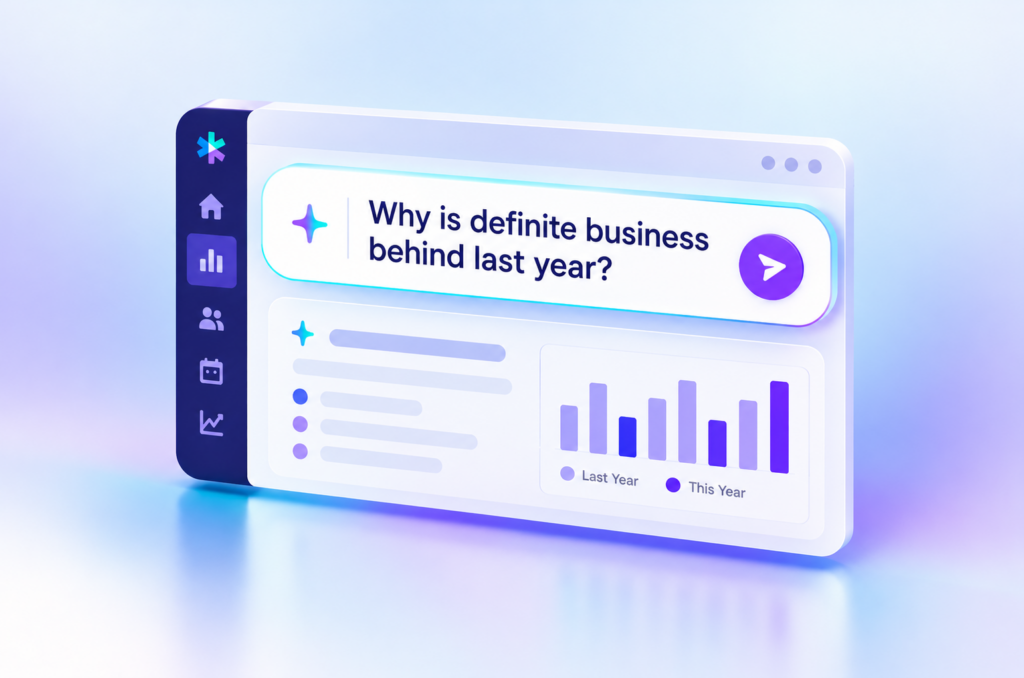
Users will be able to ask questions directly from the context of the dashboard or report they're viewing.
For example:
- “Why is definite business behind last year?”
- “Which open bookings arriving in the next 60 days need attention?”
- “What changed most significantly since last week’s review?”
The goal is to make the application more intuitive, allowing users to move naturally between visual analysis and conversational exploration.
3. Brief: Surface what deserves attention
A weekly or periodic AI-generated briefing could highlight the most important changes in performance, identify potential risks, and direct users to the relevant information.
Rather than requiring every manager to search for issues, the application can help surface them proactively.
Beyond Dashboard Explanations
While these capabilities represent a logical starting point, our vision for Zing extends much further.
Today, users typically navigate applications, select reports, apply filters, and interpret results to accomplish a task.
Increasingly, they'll be able to describe what they're trying to accomplish and allow AI to help assemble the appropriate information, analysis, and eventually application workflows.
The traditional interface doesn't disappear. It becomes one of several ways to interact with the same underlying platform.
This is an important part of our broader Amaze strategy: building a flexible application environment where traditional user interfaces and AI-driven interactions share common capabilities rather than operating as separate products.

Amaze AI Overview:
See how Amaze turns hotel data into answers, uncovers revenue opportunities, and recommends what to do next. Download the overview ››
Enterprise Trust Isn't Optional
The potential of AI in hospitality is significant, but so are the responsibilities that come with it.
Hotel sales and catering information contains commercially sensitive data, including account relationships, booking details, negotiated rates, and revenue performance.
As AI becomes more deeply integrated into enterprise applications, organizations need confidence that their information remains protected and that AI capabilities operate within appropriate governance boundaries.
Amaze is approaching its AI strategy with these requirements in mind.
Our architecture and product direction emphasize three important principles.
Permissions must carry through.
- AI-driven interactions should respect the same property-level and user-level access controls that govern information within Amaze.
Usage must be visible and manageable.
- Organizations need appropriate visibility into how AI capabilities are being used, along with controls to manage consumption and operational costs.
Answers must be grounded in trusted information.
- Numerical analysis and business conclusions should be supported by governed data and established measures, with safeguards designed to minimize unsupported or misleading responses.
This last principle is particularly important.
AI can be remarkably effective at explaining information, identifying patterns, and helping users explore complex questions. But language models are not inherently reliable sources of business facts.
That's why Amaze's approach emphasizes purpose-built tools and structured data rather than relying on a language model to generate business metrics independently.
When the available information doesn't support a reliable answer, the system should communicate that limitation rather than manufacture certainty.
We are also evaluating AI infrastructure approaches that provide appropriate security, operational control, and flexibility as the technology continues to evolve.
Ultimately, governance isn't something to add after the AI experience is built.
It's what makes that experience viable for enterprise hospitality organizations.
Missed Part 1 of the Beyond Dashboards Series?
Start with Beyond Dashboards: The Foundation of AI-Powered Hotel Sales Intelligence to discover how Amaze transforms disconnected hotel data into trusted intelligence and makes it accessible through conversational AI.
Coming Next in the Beyond Dashboards Series
From Answering Questions to Anticipating Opportunities + The Future of Hospitality Intelligence Is Open, Connected, and Actionable
Explore how AI can help hotel sales teams anticipate performance, identify revenue opportunities earlier, and turn intelligence into meaningful action.
Share This Story. Choose Your Platform!
