
Beyond Dashboards: From AI Insights to Predictive Hotel Intelligence
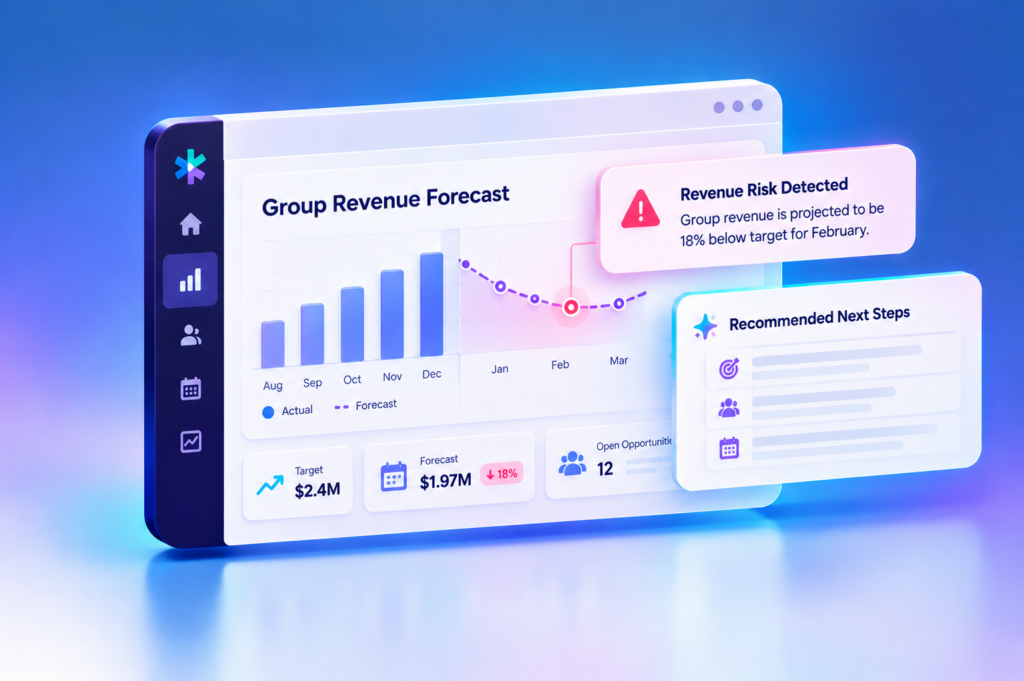

Beyond Dashboards: The Next Era of Hotel Sales Intelligence | Part 3
From Answering Questions to Anticipating Opportunities
Conversational analytics and contextual explanations are important advances, but they represent only the beginning.
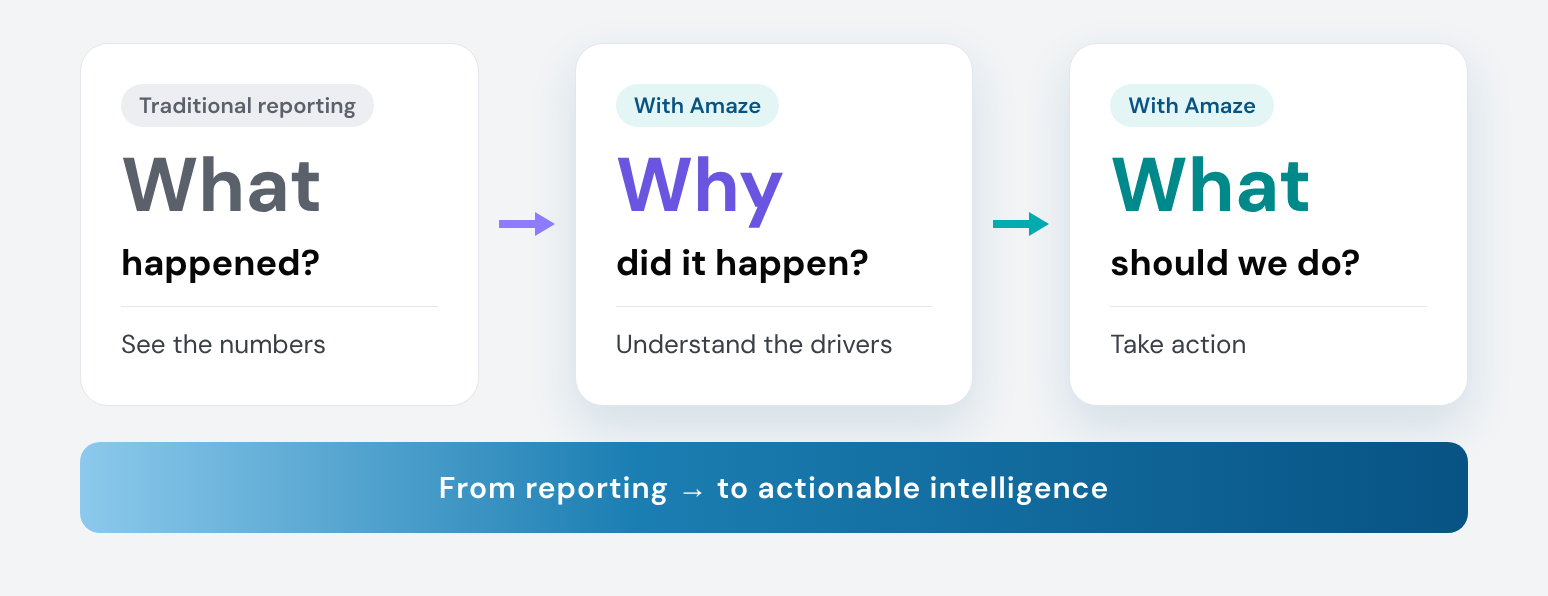
The next stage is moving beyond understanding what has happened to anticipating what is likely to happen and recommending what to do about it.
This is the progression from descriptive analytics to predictive intelligence and, ultimately, prescriptive action.
Forecasting that learns from history
Traditional pace reporting tells sales leaders where their business stands today relative to historical periods.
Predictive intelligence has the potential to tell them where that business is likely to finish.
By applying machine learning to historical booking patterns, pickup activity, conversion behavior, and other relevant measures, Amaze envisions forecasting capabilities that help hotels anticipate future group and catering performance.
Imagine knowing months in advance that a particular period is likely to underperform.
Instead of waiting until the revenue gap becomes obvious, the sales team could identify the risk early and focus its efforts on accounts and opportunities most likely to improve the outcome.
The value isn't simply a better forecast.
It's having more time to influence the result.
Smarter lead matching across the portfolio
Consider a hotel company operating multiple properties within a destination or region.
A new group inquiry arrives, but the requested hotel cannot accommodate the event because of availability, meeting space constraints, or other requirements.
Today, that opportunity may be turned away or require substantial manual coordination to find an alternative.
AI-assisted lead matching could help change that.
By evaluating dates, room requirements, meeting space needs, budget, and other relevant criteria, the platform could identify alternative properties within the portfolio that may be better suited to the opportunity.
Instead of losing the business entirely, the organization has a better chance of retaining it within the portfolio.
This illustrates how intelligence can move beyond individual-property optimization to support broader enterprise revenue opportunities.
Turning insight into action
Ultimately, the greatest value of AI may come from connecting insights directly to business workflows.
Consider a few examples:
An important account goes quiet. The platform identifies a historically productive customer with no future bookings and recommends a follow-up to the account owner.
A tentative booking remains unresolved. The system recognizes that an opportunity has remained in the same status longer than expected and prompts the seller to take action.
A future period begins to look soft. Predictive models identify a potential revenue shortfall, and the platform suggests accounts or market segments that may represent the best opportunities to fill the gap.
These are natural extensions of the intelligence Amaze is already building.
Over time, such capabilities could support increasingly automated workflows, while keeping users in control of important commercial decisions.
The objective isn't to generate more alerts, tasks, or notifications.
It's to reduce missed opportunities and help sales professionals spend more time on the activities that actually drive revenue.
The Future of Hospitality Intelligence Is Open, Connected, and Actionable
For years, the evolution of business intelligence has largely focused on making reports faster, dashboards more interactive, and information easier to visualize.
Those improvements matter, but AI introduces a much more fundamental change.
It creates the opportunity to make sophisticated analysis accessible through natural conversation, embed intelligence directly into operational workflows, and connect insights to recommended actions.
For hotel companies evaluating their own AI strategies, several principles stand out.
Start with trusted data. AI cannot compensate for inconsistent business definitions or poor data quality. A normalized, hospitality-specific foundation is essential.
Embrace openness and flexibility. Customers should be able to access intelligence through the applications and AI environments that best support their workflows, without sacrificing consistency or governance.
Move from reporting to anticipating. The greatest value comes not simply from understanding historical performance, but from identifying future risks and opportunities early enough to act.
Build trust into the architecture. Security, permissions, transparency, and appropriate controls are essential to making AI practical at enterprise scale.
At Amaze, these principles are shaping the next evolution of our platform.
Our existing data integration, normalization, and hospitality analytics capabilities provide the foundation. MCP is opening new ways for customers to access that intelligence. Amaze is extending those experiences into the application itself. Predictive analytics and AI-driven workflows represent the next opportunities to create even greater value.
These initiatives are at different stages of development, but they share a common direction.
We're building toward a future where Amaze doesn't simply tell hotel companies how they're performing. It helps them understand why, anticipate what's next, and determine where to act.
More Time to Sell. Better Information to Sell With.
AI won't replace the relationships, creativity, and judgment that define successful hotel sales organizations.
Those qualities will remain central to winning group and catering business.
What AI can do is remove much of the friction between having a question, understanding an opportunity, and taking meaningful action.
- It can help a Director of Sales identify a problem before it becomes a missed target.
- It can help an account manager recognize a valuable relationship that needs attention.
- It can help a portfolio leader understand where demand is shifting and how to respond.
- And it can help an entire organization make better use of information that has historically been difficult to access, interpret, and act upon.
The future of hospitality intelligence isn't simply about generating more reports or building more dashboards.
It's about making the intelligence behind them more accessible, more contextual, and ultimately more actionable.
At Amaze Insights, that's the future we're building: turning hospitality data into better decisions, stronger relationships, and more revenue opportunities.
Catch Up on the Beyond Dashboards Series
Part 1: The Foundation of AI-Powered Hotel Sales Intelligence
Discover how Amaze transforms disconnected hotel data into trusted intelligence and makes it accessible through conversational AI.
Part 2: Bringing Trusted AI Into Hotel Sales Workflows
Explore how Amaze brings AI-powered insights into everyday hotel workflows while protecting sensitive business data through enterprise-level security and governance.
Share This Story. Choose Your Platform!
